How to Brew Oolong Tea: Temperature, Steeping Time & Traditional Methods
How do you brew oolong tea? Start with fresh water heated to approximately 185–205°F (85–96°C), depending on the style of oolong. Use about 4–5 grams of loose-leaf tea per 8 ounces of water and steep for approximately 2–4 minutes. For traditional Chinese gongfu brewing, use more tea, less water, and several short infusions.
Oolong tea can range from light, floral teas to dark, roasted varieties, so there is no single brewing recipe that works perfectly for every tea. Water temperature, tea quantity, steeping time, and brewing method all affect the final cup.
This guide explains how to brew oolong tea correctly, including recommended temperature and steeping times, Western-style brewing, traditional Chinese gongfu brewing, multiple infusions, common mistakes, and practical ways to adjust your technique.
What Is Oolong Tea?
Oolong tea is a partially oxidized tea made from the leaves of Camellia sinensis, the same plant used to produce green, black, white, and pu-erh teas.
What makes oolong different is its processing. The leaves undergo controlled oxidation before being shaped, dried, and sometimes roasted. The degree of oxidation and the production techniques used can vary considerably.
As a result, "oolong tea" describes a broad family of teas rather than one uniform flavor profile.
Depending on the tea, oolong may have aromas and flavors reminiscent of:
- Flowers
- Fresh herbs
- Stone fruit
- Citrus
- Honey
- Cream
- Toasted grains
- Nuts
- Dried fruit
- Roasted wood
This diversity is important when learning how to brew oolong tea. A lightly oxidized, floral oolong may respond differently to water temperature than a darker, heavily roasted tea.
What Temperature Should You Use for Oolong Tea?
The ideal oolong tea brewing temperature depends on the particular tea.
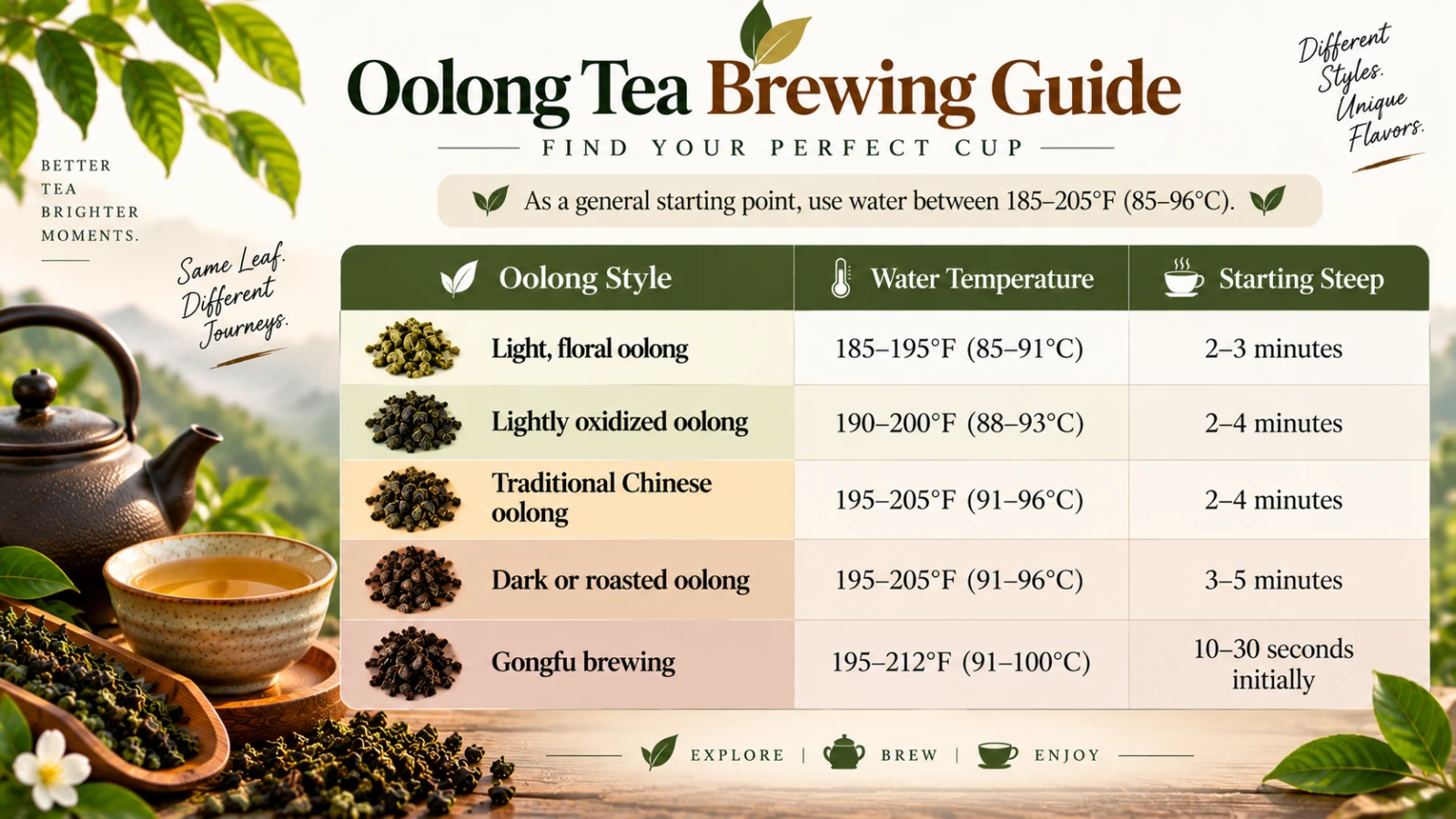
These temperatures are guidelines rather than strict rules.
If a delicate oolong tastes bitter or overly astringent, try lowering the temperature. If a robust roasted oolong tastes weak, slightly hotter water may help extract more of its flavor.
The tea itself should ultimately guide your adjustments.
How Long Should You Steep Oolong Tea?
For conventional Western-style brewing, 2–4 minutes is a useful starting point.
For traditional gongfu brewing, the first infusions are much shorter, often around 10–30 seconds.
The important relationship is between leaf quantity, water volume, temperature, and steeping time.
Using more tea generally means you can use shorter infusions. Using less tea may require more time.
If your oolong tastes too strong or bitter, shorten the steep. If it tastes weak, increase the amount of tea or extend the infusion slightly.
How to Brew Oolong Tea Western-Style
Western-style brewing uses a larger volume of water and fewer tea leaves than gongfu brewing. It is one of the easiest ways to prepare oolong at home.
What You Need
You will need:
- Loose-leaf oolong tea
- A teapot or mug
- An infuser
- Fresh water
- A kettle
- A timer
Step 1: Measure the Oolong Tea
Start with approximately 4–5 grams of tea per 8 ounces of water.
If you do not have a scale, approximately one teaspoon of loose-leaf tea is a reasonable starting point, although the volume varies depending on the shape and size of the leaves.
Tightly rolled oolong leaves can look like a small amount of tea before brewing but expand considerably once hydrated.
Step 2: Heat Fresh Water
Use fresh, clean water.
For many oolong teas, begin around 190–200°F (88–93°C).
If you are brewing a delicate oolong, slightly cooler water may help preserve its floral and lighter characteristics.
For darker or roasted oolongs, hotter water can often be used.
Step 3: Preheat the Teapot or Cup
Pour a little hot water into the brewing vessel, swirl it around, and discard it.
Preheating is optional, but it can help maintain a more consistent brewing temperature.
Step 4: Add the Tea Leaves
Place the leaves inside the infuser or directly into the teapot.
Give the leaves sufficient space to expand. Avoid using an infuser that compresses tightly rolled leaves into a small space.
Step 5: Add the Water
Pour the heated water over the leaves, making sure they are fully submerged.
Step 6: Steep for 2–4 Minutes
Start with approximately 2–4 minutes.
Once the desired time has passed, remove the infuser or pour the tea completely from the teapot.
Taste the tea before deciding what to change.
If it is too strong, reduce the brewing time. If it is too weak, increase the amount of tea or steep slightly longer.
How to Brew Oolong Tea Gongfu-Style
Gongfu brewing is a traditional Chinese tea preparation method that uses a relatively high quantity of leaves, a small brewing vessel, and multiple short infusions.
Rather than making one large pot of tea, gongfu brewing allows you to observe how the flavor and aroma develop from infusion to infusion.
This method is particularly useful for whole-leaf oolong teas.
What You Need for Gongfu Brewing
A basic setup can include:
- A gaiwan or small teapot
- Loose-leaf oolong
- Hot water
- Small tasting cups
- A fairness pitcher, if desired
You do not need an elaborate tea set. A small gaiwan and suitable cups are enough to begin.
Step 1: Use More Tea and Less Water
A practical starting point is approximately 5–8 grams of tea for a 100–120 ml gaiwan.
The relatively high leaf-to-water ratio is one of the defining features of this brewing approach.
Step 2: Heat the Water
For many oolong teas, approximately 195–205°F (91–96°C) is a useful starting point.
More robust roasted oolongs can often be brewed with water closer to boiling.
Step 3: Warm the Gaiwan
Rinse the gaiwan with hot water and discard the water.
This warms the brewing vessel and helps maintain a stable temperature.
Step 4: Add the Oolong Leaves
Place the dry leaves into the gaiwan.
Before adding water, smell the dry leaves. Their aroma can provide an early indication of the tea's character.
Step 5: Rinse the Leaves if Desired
A brief rinse is common in some traditional Chinese brewing practices.
Pour hot water over the leaves, allow them to sit very briefly, and discard the liquid.
However, rinsing is not mandatory for every oolong. For casual brewing, you can simply begin with the first infusion.
Step 6: Brew the First Infusion
Add hot water and steep for approximately 10–20 seconds to begin.
Pour the tea completely out of the gaiwan.
Step 7: Continue With Multiple Infusions
The next infusion can be similar in length or gradually increased depending on the tea.
A starting framework might look like this:
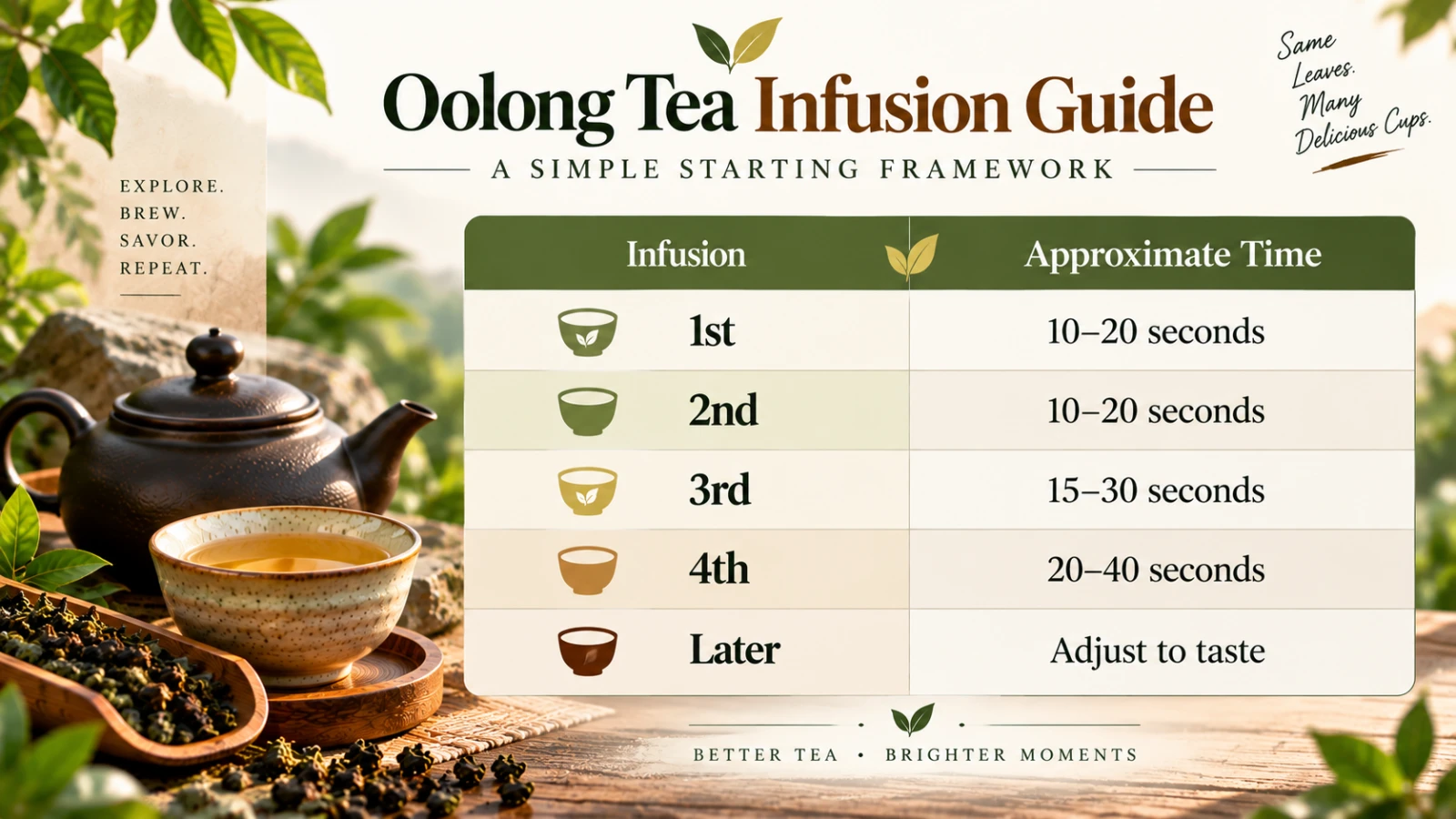
These times are not fixed rules. Some oolongs release flavor quickly, while others require longer infusions.
Why Can Oolong Tea Be Brewed Multiple Times?
Many whole-leaf oolong teas are suitable for multiple infusions.
During brewing, the leaves gradually absorb water and unfold. This can change the relationship between the water and the interior portions of the leaves, allowing the character of the tea to develop across successive infusions.
The first infusion may emphasize aroma, while later infusions can reveal additional body, sweetness, roasted notes, or other characteristics.
Eventually, the flavor becomes lighter.
The number of worthwhile infusions depends on the tea, leaf quantity, processing, water, and brewing method. There is no universal number of times that every oolong should be steeped.
Should You Rinse Oolong Tea Before Brewing?
You do not have to rinse oolong tea before brewing.
A brief rinse is often associated with traditional gongfu preparation, particularly for tightly rolled or heavily processed teas.
It may help loosen the leaves and remove loose particles from the surface.
However, rinsing is not a requirement for producing good tea. If you are making oolong in a mug or standard teapot, simply brewing the leaves directly is perfectly reasonable.
If you choose to rinse, keep the rinse brief. A prolonged rinse can begin extracting the tea rather than simply preparing the leaves.
The Best Water for Brewing Oolong Tea
Good tea starts with good water.
Use water that tastes clean on its own. Filtered water can be useful if your tap water has a noticeable chlorine taste or high mineral content.
Very hard water can sometimes make tea taste dull or alter its perceived bitterness and astringency.
There is no need to use expensive specialty water to brew oolong. The practical objective is simply to use clean water with a neutral, pleasant flavor.
Avoid repeatedly boiling the same water when possible. Freshly heated water is generally preferable.
Common Oolong Tea Brewing Mistakes
1. Using the Same Temperature for Every Oolong
Oolong is a broad category. A delicate floral tea and a heavily roasted tea may respond differently to the same water temperature.
Use the recommended temperature as a starting point, then adjust according to the tea.
2. Steeping for Too Long
Longer steeping does not necessarily produce better tea.
If your oolong tastes harsh or bitter, try reducing the brewing time.
3. Using Too Little Tea
Using too little leaf in a large volume of water can produce a thin or weak cup.
Before dramatically increasing the steeping time, try adding more tea.
4. Using a Small, Crowded Infuser
Rolled oolong leaves can expand significantly.
If the leaves cannot open properly, the water may not circulate effectively around them.
5. Failing to Empty the Brewing Vessel
When making multiple infusions, pour the tea completely out after each steep.
Leaving brewed tea sitting with the leaves will continue extracting the tea and can result in an overly strong or bitter infusion.
How to Adjust Your Oolong Tea Brewing Technique
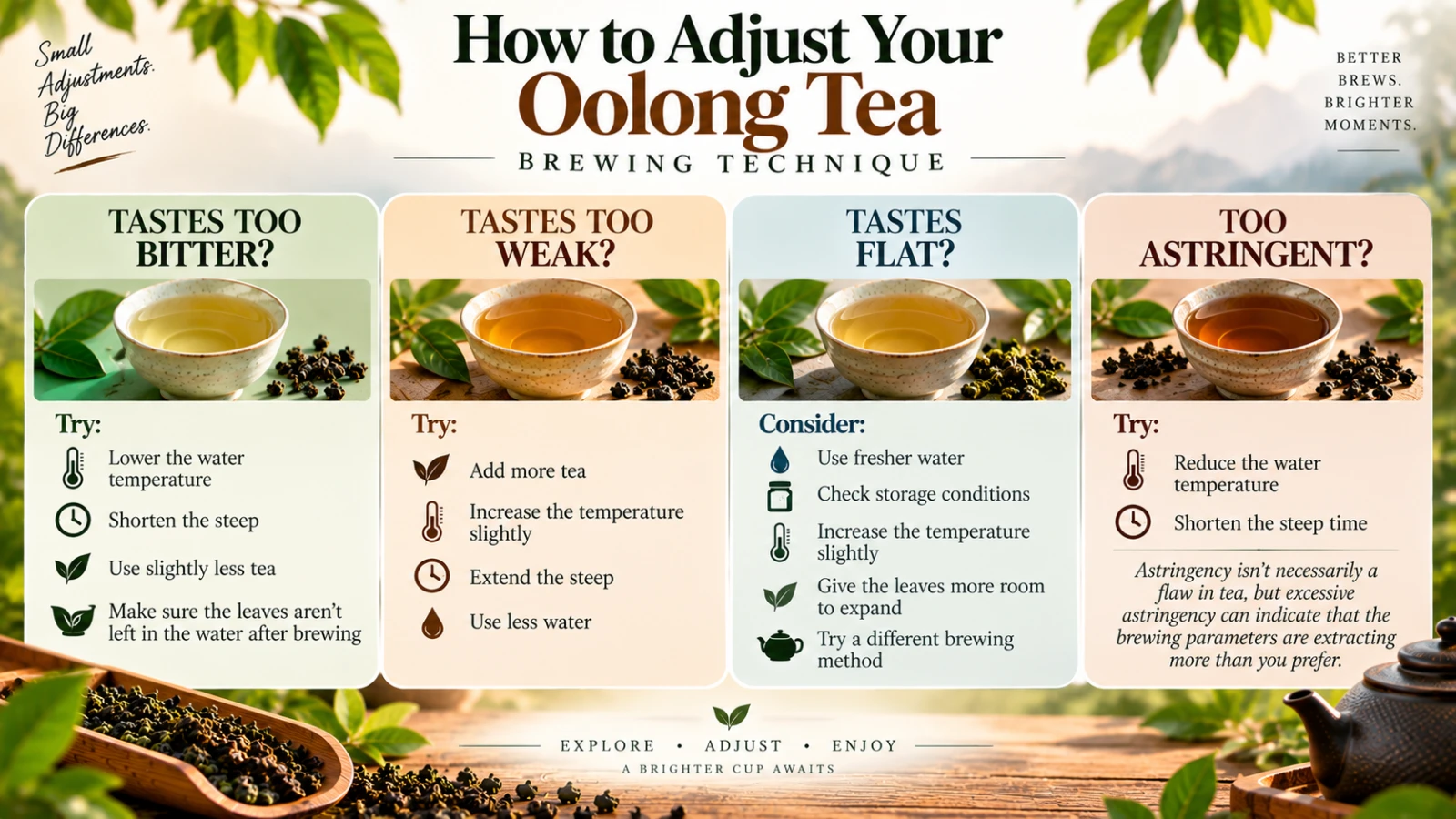
Learning how to brew oolong tea properly is ultimately about learning how to make small adjustments.
If Your Oolong Tastes Too Bitter
Try:
- Lowering the water temperature
- Shortening the steep
- Using slightly less tea
- Checking that the leaves are not remaining in the water after brewing
If Your Oolong Tastes Too Weak
Try:
- Adding more tea
- Increasing the temperature slightly
- Extending the steep
- Using less water
If Your Oolong Tastes Flat
Consider:
- Using fresher water
- Checking the tea's storage conditions
- Increasing the temperature slightly
- Giving the leaves more room to expand
- Trying a different brewing method
If the Tea Is Too Astringent
Try reducing the water temperature or steeping time.
Astringency is not necessarily a flaw in tea, but excessive astringency can indicate that the brewing parameters are extracting more than you prefer.
A Simple Oolong Tea Brewing Recipe
If you are new to oolong, start here:
For one 8-ounce cup:
- Tea: 4–5 grams loose leaf
- Water: 8 ounces
- Temperature: 190–200°F (88–93°C)
- Steeping time: 2–4 minutes
- Reinfusions: Try the leaves again and adjust the time according to taste
For gongfu brewing:
- Tea: 5–8 grams
- Water: 100–120 ml
- Temperature: 195–205°F (91–96°C)
- First infusion: 10–20 seconds
- Later infusions: Gradually increase as needed
These recipes are starting points rather than rigid formulas.
How to Get More Flavor From Oolong Tea
The most useful approach is to change one variable at a time.
For example, if your first cup tastes weak, add more tea without changing the temperature or brewing time. If that improves the flavor, you have identified one useful adjustment.
Next time, you can experiment with temperature.
Keeping the changes small makes it easier to understand how the tea responds.
This is particularly useful when exploring different Chinese oolongs because their processing and leaf characteristics can vary substantially.
How to Taste Oolong Tea
Brewing is only part of the experience.
Before drinking, smell the dry leaves. Then observe the aroma after adding water.
When tasting the tea, consider:
- Aroma
- Flavor
- Body or mouthfeel
- Bitterness
- Astringency
- Sweetness
- Aftertaste
- Changes between infusions
Do not worry about identifying a specific tasting note every time.
Instead, focus on how the tea changes and which characteristics you enjoy.
With experience, you will become more comfortable recognizing differences between floral, fruity, roasted, mineral, nutty, and other profiles.
Final Thoughts: Brewing Oolong Tea With Confidence
Learning how to brew oolong tea does not require complicated equipment or a rigid recipe.
Start with clean water, choose a suitable temperature, give the leaves room to expand, and use a moderate steeping time. For many oolongs, 190–200°F (88–93°C) and 2–4 minutes is a practical starting point.
As you become more familiar with oolong, experiment with gongfu brewing and multiple short infusions. You may find that the tea changes considerably from one infusion to the next.
The most useful lesson is to treat brewing guidelines as starting points. Different oolongs have different characteristics, and adjusting temperature, leaf quantity, and steeping time can help reveal what makes each tea distinctive.
If you would like to explore authentic Chinese oolong teas, Stepman's Tea offers a selection of carefully chosen teas that can be explored using both everyday and traditional brewing methods. Learning how to brew each tea according to its characteristics is part of the process of understanding and appreciating Chinese tea.
FAQs
1. What is the best temperature for oolong tea?
A temperature of approximately 185–205°F (85–96°C) is a useful starting range. Delicate oolongs may benefit from cooler water, while darker and roasted oolongs can often tolerate hotter water.
2. How long should oolong tea steep?
For Western-style brewing, start with 2–4 minutes. For gongfu brewing, start with approximately 10–30 seconds and adjust the time as you continue infusing the leaves.
3. Can you use boiling water for oolong tea?
Yes. Some robust and roasted oolongs can be brewed with water close to boiling. More delicate oolongs may taste better when brewed at a lower temperature.
4. How many times can you steep oolong tea?
Many whole-leaf oolongs can be infused multiple times. The exact number depends on the tea, leaf quantity, water, temperature, and brewing method.
5. Do you need to rinse oolong tea?
No. Rinsing is optional. It is commonly used in some gongfu brewing practices but is not necessary for ordinary brewing.
6. Should you add milk or sugar to oolong tea?
Oolong is traditionally enjoyed without additions, allowing the tea's natural aromas and flavors to be experienced directly. However, personal preference ultimately determines how you choose to drink it.
7. Why does my oolong tea taste bitter?
The most common brewing-related causes are excessive temperature, too much tea, or too long an infusion. Try reducing the temperature or steeping time.
8. What is the difference between gongfu and Western-style oolong brewing?
Western-style brewing generally uses more water and fewer leaves with a longer infusion. Gongfu brewing uses more leaves, less water, and multiple short infusions.