How Sheng Pu-erh Changes With Age
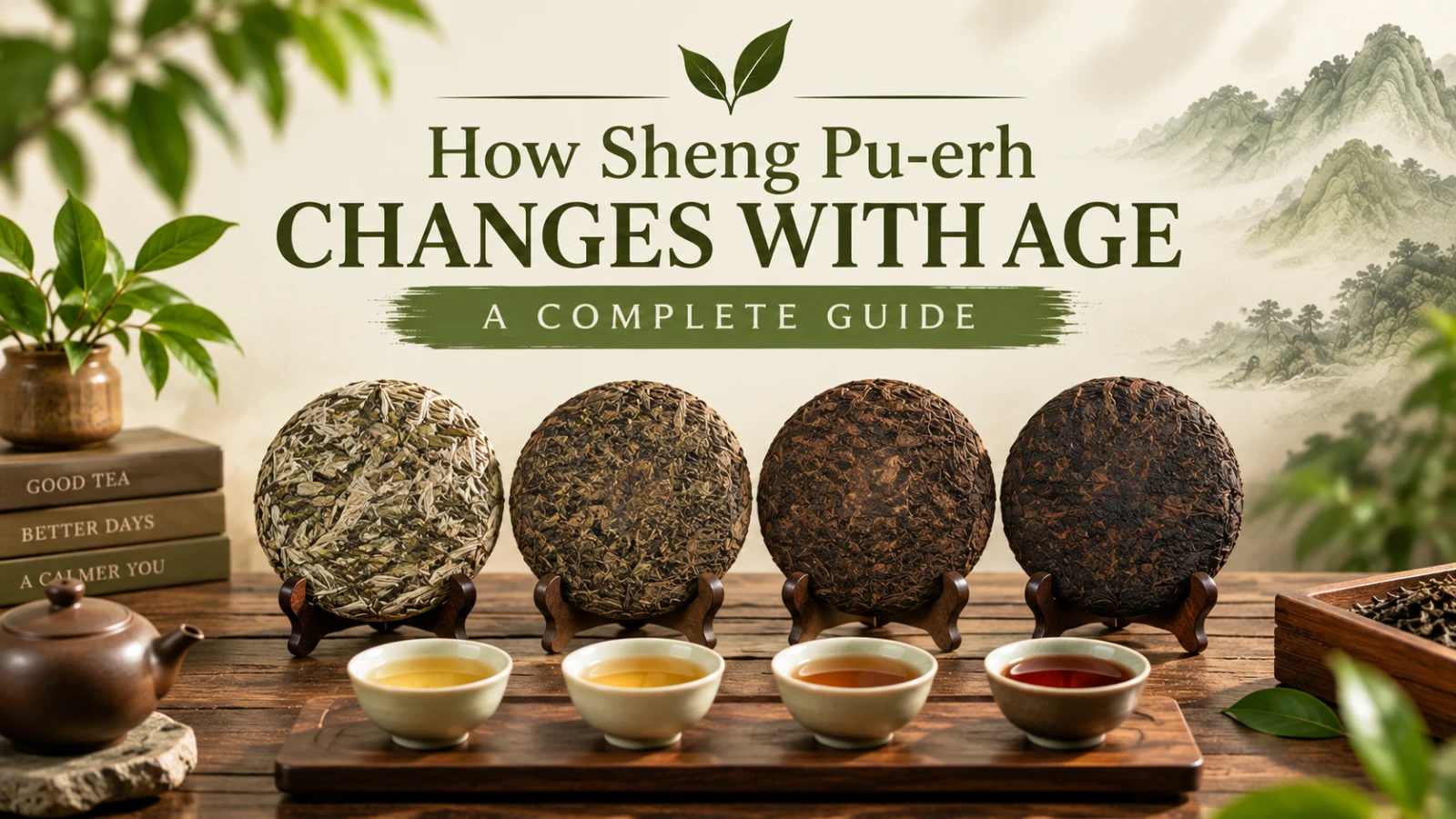
Sheng Pu-erh, often called Raw Pu-erh, is one of the few teas whose character can continue to change for years or even decades after it leaves the tea factory. A young Sheng Pu-erh may be fresh, aromatic, bitter, astringent, and energetic, while a well-stored older tea can develop deeper aromas, softer texture, greater sweetness, and a more integrated flavor.
But aging Sheng Pu-erh is not simply a matter of putting a tea cake on a shelf and waiting.
The transformation depends on the tea's original material, processing, compression, storage environment, temperature, humidity, airflow, and time. Modern research is increasingly helping explain what experienced tea drinkers have observed for generations: aging involves complex changes in the tea's chemical composition, aroma compounds, and microbial environment.
Understanding these changes can make it easier to appreciate aged Sheng Pu-erh—and to make better decisions when buying, storing, and brewing it.
What Is Sheng Pu-erh?
Sheng Pu-erh is traditionally produced in Yunnan, China, using tea leaves generally associated with large-leaf varieties of Camellia sinensis. The leaves are processed into sun-dried tea, known as mao cha, which may then be left loose or compressed into forms such as cakes, bricks, or tuos.
Unlike Shu, or Ripe Pu-erh, Sheng Pu-erh does not undergo the accelerated wet-piling process known as wo dui during production.
Instead, Sheng Pu-erh is designed to develop gradually through storage.
This distinction is important. Sheng does not simply become Shu as it gets older. Natural aging changes the original Sheng tea over time, but it does not recreate the accelerated production process used to make Shu Pu-erh.
The tea's connection to Yunnan is also part of a much older tea culture. UNESCO's documentation of the Jingmai Mountain tea landscape in Pu'er describes tea cultivation traditions maintained by Blang and Dai communities for more than a thousand years.
Why Does Sheng Pu-erh Change With Age?
Freshly produced Sheng Pu-erh contains a range of compounds that contribute to its youthful character, including catechins and other polyphenols, amino acids, aromatic compounds, and pigments.
Over time, these compounds do not remain completely static.
Storage allows chemical reactions and, under appropriate conditions, microbial activity to continue influencing the tea. Oxidation, hydrolysis, degradation, and other transformations gradually alter the balance of compounds responsible for bitterness, astringency, aroma, color, and mouthfeel.
Recent research specifically examining raw Pu-erh has found that natural storage is associated with significant changes in taste and chemical composition. Studies have identified changes in catechin-related compounds and other metabolites, while sensory analysis has shown that stored raw Pu-erh can develop greater complexity and different levels of bitterness, astringency, sweetness, sourness, and mouthfeel.
In simple terms, aging does not add something artificial to Sheng Pu-erh. It gradually changes what is already in the tea.
The Main Stages of Sheng Pu-erh Aging
There is no universal timetable for aging. Two teas that are both labeled "10-year-old Sheng" can taste dramatically different.
Nevertheless, aging can be understood in broad stages.
Young Sheng Pu-erh: Fresh, Bright and Structured
Young Sheng Pu-erh often has a distinctly fresh character.
Depending on the tea, you may notice:
- Floral or herbaceous aromas
- Fresh fruit or stone-fruit notes
- Vegetal or green-tea-like qualities
- Noticeable bitterness
- Pronounced astringency
- Bright acidity
- Strong aromatic lift
- A lingering aftertaste
Bitterness and astringency are not necessarily signs of poor quality.
In a well-made young Sheng, they can be part of the tea's structure. Some teas also produce huigan, a traditional Chinese tea term describing a returning sweetness that becomes noticeable after the initial bitterness or astringency.
At this stage, the tea may feel energetic and sharply defined rather than rounded.
Developing Sheng: Greater Integration
As storage progresses, the tea can gradually lose some of its youthful sharpness.
Research examining raw Pu-erh has identified significant changes in taste-related compounds during storage, including transformations involving catechins and other phenolic constituents. One study found that five years of storage represented an important point of chemical and sensory change in crude/raw Pu-erh.
The exact sensory result depends heavily on the tea and its storage history.
A developing Sheng may begin to show:
- Softer bitterness
- Reduced sharpness
- Fuller mouthfeel
- More integrated flavors
- Increased sweetness
- Deeper fruit or floral notes
- Woody or herbal characteristics
- More persistent aftertaste
Rather than simply becoming "stronger," the tea often becomes more integrated.
Mature Sheng: Deeper, Smoother and More Complex
With extended, appropriate storage, some Sheng Pu-erh develops characteristics associated with mature tea.
These can include:
- Woody aromas
- Dried fruit
- Herbs
- Camphor-like notes
- Earthier tones
- Honeyed sweetness
- Deeper color
- A smoother texture
- Reduced aggressive bitterness
- A long, lingering finish
Recent research into raw Pu-erh has found that woody aroma becomes substantially more prominent during storage, with changes in volatile compounds contributing to the characteristic aroma of aged tea.
However, "older" should never automatically be interpreted as "better."
Age is only one variable.
A younger Sheng made from excellent material and stored appropriately can be more enjoyable than an older tea that was poorly processed or badly stored.
What Actually Happens to the Tea?
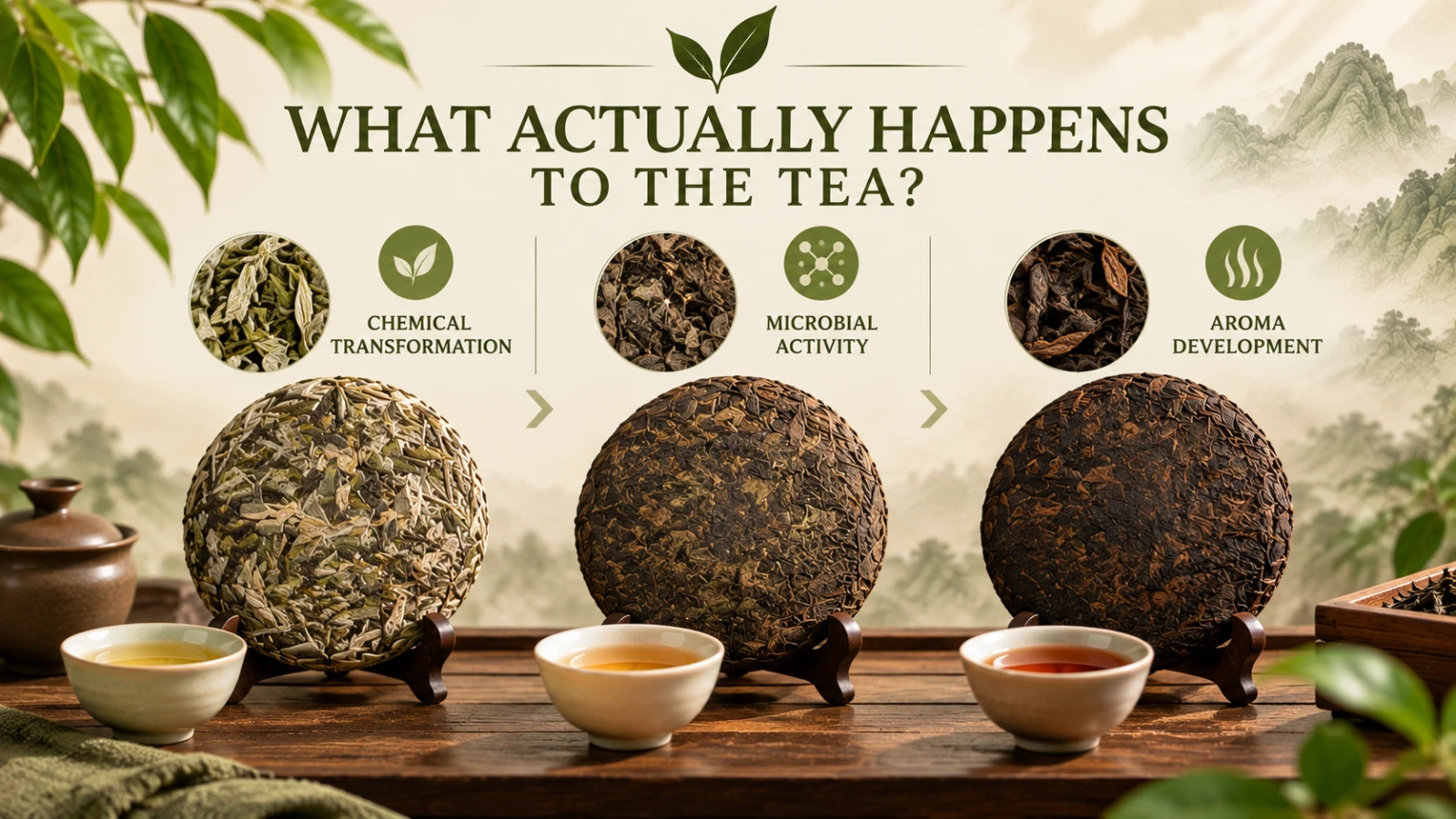
The changes associated with Sheng Pu-erh aging are complicated because several processes can occur simultaneously.
Oxidation and Chemical Transformation
Tea contains polyphenols and other compounds that can change through oxidation and related reactions.
During storage, some compounds decrease while others form or become more prominent. These transformations affect the tea's color, aroma, bitterness, astringency, and overall sensory balance.
Research on raw Pu-erh has identified changes involving catechin derivatives, amino acids, flavonoids, and other metabolites as the tea ages.
The result is not simply "less bitterness."
Rather, the relationship between different taste compounds changes, which can make the tea feel more rounded.
Microbial Activity
Microorganisms also play a role in Pu-erh's development.
This does not mean that properly stored Sheng Pu-erh is simply "moldy tea." The microbial environment is much more complex than that.
Recent research has shown that the microbial community associated with raw Pu-erh can influence chemical transformations during storage. Controlled experiments have also demonstrated that water activity affects microbial composition and the formation of flavor-related compounds.
This is one reason storage conditions matter so much.
The goal is not to make the tea as damp as possible. Excessive moisture can encourage undesirable microbial activity and off-aromas.
Aroma Development
One of the most noticeable differences between young and aged Sheng can be aroma.
Fresh teas may emphasize floral, vegetal, fruity, or herbal notes. With age, the aromatic profile can become deeper and more layered.
A 2025 study of raw Pu-erh found that woody aroma increased substantially during storage and linked the development of aged aroma to changes in volatile compounds.
This helps explain why an older Sheng can smell dramatically different from the same tea when young.
Why Storage Matters So Much
Aging is not controlled by the calendar alone.
Storage is part of the aging process.
Temperature, humidity, airflow, packaging, and the surrounding environment can all influence how tea develops.
Recent research has demonstrated that different storage containers can produce measurable differences in the flavor of raw Pu-erh. Researchers linked these differences to the microclimate created inside different storage environments, including changes involving phenolic oxidation, fatty-acid oxidation, and carotenoid degradation.
Another 2026 study found that environmental factors, including temperature and humidity, were strongly associated with flavor differences in raw Pu-erh stored for 13 years.
This is why two cakes from the same production year can taste surprisingly different.
One may have been stored in a warm, humid environment with good airflow. Another may have spent years in a dry climate or in packaging that restricted air exchange.
The resulting teas may no longer taste alike.
Does Sheng Pu-erh Need Humidity to Age?
Humidity is one of the most misunderstood aspects of Pu-erh storage.
Sheng Pu-erh does require some moisture in the environment for aging-related processes to occur, but more humidity is not automatically better.
Recent research investigating water activity in raw Pu-erh found that controlled water activity affected microbial communities and flavor development. The researchers identified a range around 0.60–0.70 as favorable under their experimental conditions, while higher levels were associated with undesirable volatile compounds.
This is useful scientifically, but home storage should not be reduced to chasing a particular laboratory number.
For everyday storage, the more practical principle is:
Keep Sheng Pu-erh in a clean, stable environment with moderate humidity and good protection from moisture, odors, and contamination.
Avoid damp basements, sealed containers that trap condensation, and environments with strong household smells.
How to Store Sheng Pu-erh at Home
If you want to age Sheng Pu-erh yourself, consistency is more important than trying to create extreme conditions.
1. Keep the Tea Away From Strong Odors
Tea leaves readily interact with their surrounding environment.
Do not store Pu-erh next to:
- Spices
- Coffee
- Incense
- Cleaning products
- Perfume
- Strongly scented foods
A tea that spends years absorbing surrounding odors may develop an aroma that has little to do with its original character.
2. Avoid Excessive Moisture
Humidity can support aging, but excessive moisture can create problems.
Do not intentionally expose cakes to water or store them somewhere visibly damp.
If tea develops obvious mold, unusual wetness, or unpleasant odors, it should not simply be assumed to be "good fermentation."
3. Avoid Extreme Temperature Changes
A relatively stable environment is preferable to repeated cycles of intense heat and cooling.
Large temperature swings can influence condensation and the tea's microenvironment.
4. Allow Appropriate Air Exchange
Completely airtight storage is not always ideal for traditionally aged Sheng.
At the same time, leaving tea completely exposed is not advisable.
A clean, breathable storage environment can provide a useful balance between protection and air exchange.
5. Keep Different Teas Separate
If possible, store teas with substantially different aromas separately.
This is especially useful when aging multiple cakes from different regions or production styles.
How to Tell Whether an Aged Sheng Is Good
When purchasing aged Sheng Pu-erh, avoid judging quality from the year alone.
A tea labeled "20 years old" is not automatically superior to a carefully made 8-year-old tea.
Instead, consider:
Original Material
Where were the leaves grown?
Was the tea produced from good-quality material?
Mountain, village, cultivar, harvest season, and leaf material can all contribute to the tea's character.
Processing
Traditional processing matters because the initial tea provides the foundation for later aging.
If the tea was poorly processed, aging cannot necessarily correct those problems.
Storage History
This is one of the most important questions to ask.
A credible seller should be able to provide as much information as reasonably available about where and how the tea was stored.
Aroma and Taste
Look for balance rather than simply intensity.
A well-aged Sheng may be aromatic without smelling perfumed, complex without tasting chaotic, and smooth without becoming flat.
Physical Appearance
Aged tea can change in color and appearance, but appearance alone is not enough to establish quality or age.
Tea should be evaluated through its provenance, storage history, dry-leaf aroma, liquor, mouthfeel, and aftertaste.
Common Misconceptions About Sheng Pu-erh Aging
"Older Always Means Better"
Not necessarily.
Age can create desirable characteristics, but quality depends on the starting material, processing, storage, and individual preference.
"All Sheng Becomes Smooth After 10 Years"
There is no universal ten-year transformation.
Different teas age at different rates.
Some young Sheng can remain powerful and structured for many years, while others become softer relatively quickly.
"Aged Pu-erh Should Taste Earthy"
Earthiness can occur in aged tea, but it is not a requirement.
A good aged Sheng can show woody, floral, herbal, fruity, resinous, sweet, or camphor-like characteristics depending on the tea and its storage.
"Humidity Is the Secret to Fast Aging"
Humidity is only one variable.
Excessive moisture can create quality and safety problems rather than better tea.
"Sheng and Shu Are the Same Tea at Different Ages"
They are not.
Sheng undergoes gradual natural aging, while Shu Pu-erh is produced using an accelerated microbial fermentation process. The two can share some characteristics as they mature, but their production histories remain fundamentally different.
How to Brew Aged Sheng Pu-erh
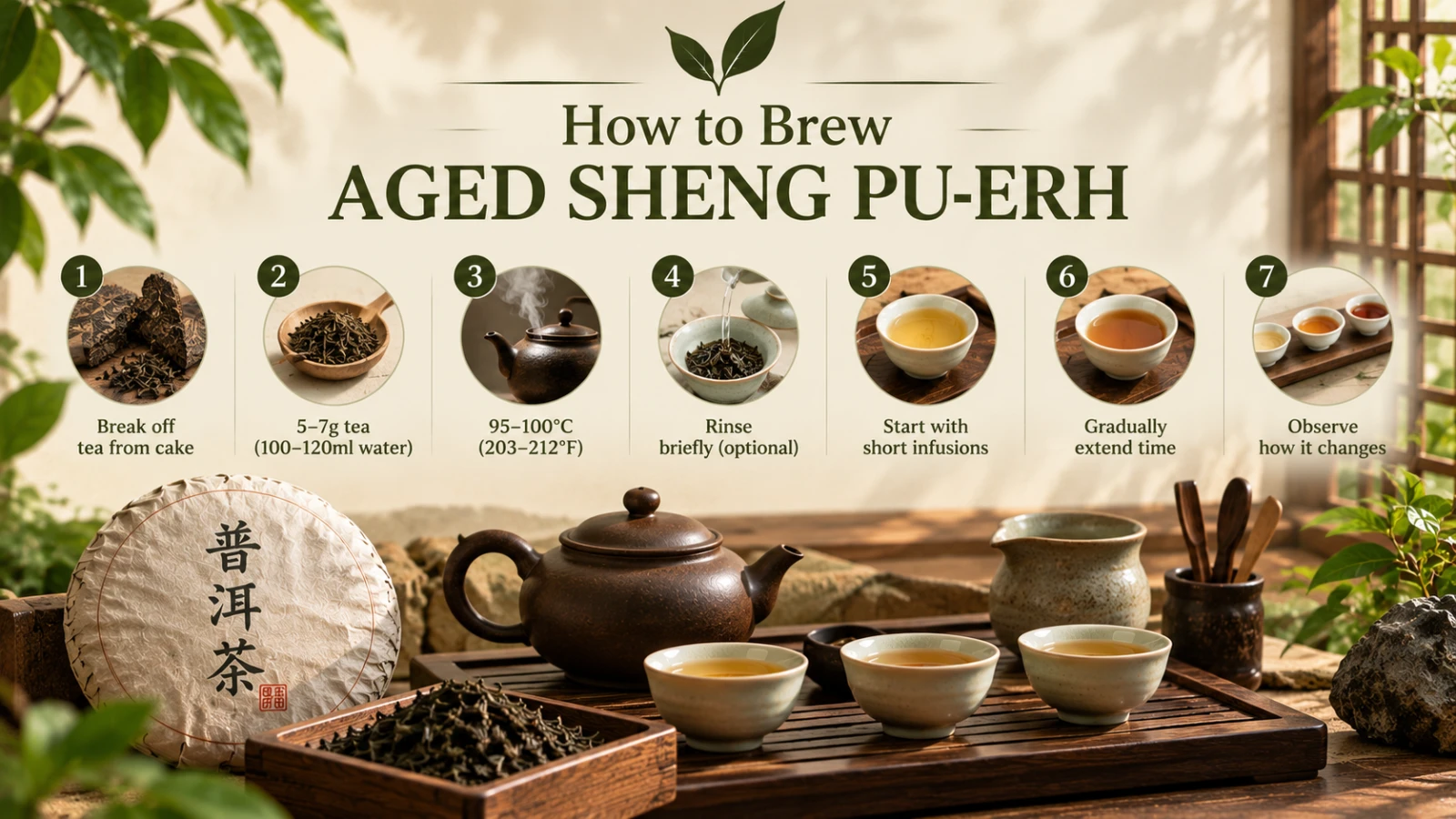
Aged Sheng generally benefits from a brewing approach that allows you to observe its changing character.
For a traditional gongfu-style preparation:
- Break off a small amount of tea from the cake.
- Use approximately 5–7 grams of tea for 100–120 ml of water.
- Use water around 95–100°C / 203–212°F.
- Rinse the leaves briefly if desired.
- Begin with short infusions.
- Gradually extend the infusion time as the leaves open.
- Pay attention to how the tea changes from the first infusion to the last.
Do not judge the tea from a single infusion.
One of the pleasures of Sheng Pu-erh is observing how aroma, bitterness, sweetness, texture, and aftertaste develop throughout a session.
For particularly delicate or older teas, slightly cooler water and shorter infusions can also be useful if the tea becomes overly intense.
Should You Buy Young or Aged Sheng Pu-erh?
The answer depends on what you want from the tea.
Young Sheng may appeal to drinkers who enjoy:
- Bright aromatics
- Freshness
- Bitterness
- Astringency
- Floral or fruity notes
- A more energetic profile
Aged Sheng may appeal to those who prefer:
- Softer bitterness
- Deeper aroma
- Woody or herbal notes
- Greater roundness
- More integrated flavor
- Long, lingering sweetness
For someone new to Pu-erh, tasting the same style at different ages can be more educational than immediately searching for the oldest possible tea.
It allows you to experience aging as a process rather than treating age as a number.
The Most Important Thing to Remember
Sheng Pu-erh does not simply become "better" with time.
It becomes different.
With suitable storage, chemical, sensory, and microbial changes can gradually transform the tea. Bitterness and astringency may soften, aromas can deepen, texture can become more rounded, and new woody, herbal, fruity, or sweet characteristics can emerge. Research increasingly supports these traditional observations, while also demonstrating just how strongly storage conditions influence the final result.
The most useful way to think about aged Sheng is therefore not as a race toward an older vintage, but as a long process of change, preservation, and balance.
Conclusion
Sheng Pu-erh is unusual because its story does not end when the tea is manufactured. Under suitable storage conditions, the tea can continue evolving for years, with changes in its chemical composition, microbial environment, aroma, taste, and texture.
Young Sheng often emphasizes freshness, bitterness, astringency, and bright aromatics. As it develops, those qualities may become more integrated, while deeper aromas, softer texture, sweetness, and woody or herbal characteristics emerge.
But aging is not automatic, and age alone does not determine quality. The original tea, production methods, storage environment, and provenance all matter.
For tea drinkers, the best approach is simple: learn the tea, taste it carefully, understand its storage history, and judge quality by the cup rather than the number on the wrapper.
If you'd like to experience authentic Sheng Pu-erh and other traditional Chinese teas, explore Stepman's Tea carefully selected collection and compare teas at different stages of development. The most rewarding way to understand Pu-erh aging is ultimately to taste how time changes the tea for yourself.
FAQs
1. Does Sheng Pu-erh get better with age?
Not necessarily. Sheng Pu-erh generally changes with age rather than automatically becoming better. Proper aging can soften bitterness and astringency and develop deeper aromas, sweetness, and texture, but the final quality depends on the original tea, processing, storage conditions, and personal preference.
2. How long does Sheng Pu-erh take to age?
There is no fixed aging period. Some changes can become noticeable within several years, while more substantial transformation can take much longer. Temperature, humidity, airflow, tea material, compression, and storage conditions all influence the rate and character of aging.
3. What does aged Sheng Pu-erh taste like?
Aged Sheng can develop deeper and more integrated flavors, including woody, herbal, dried-fruit, honeyed, resinous, or camphor-like characteristics. Bitterness and astringency may become softer, although the exact profile varies considerably between teas.
4. Does Sheng Pu-erh naturally ferment?
Sheng Pu-erh can undergo gradual microbial and chemical changes during storage, but this should not be confused with the accelerated fermentation process used to produce Shu Pu-erh. Natural Sheng aging occurs over an extended period and depends strongly on the storage environment.
5. Can you age Sheng Pu-erh at home?
Yes. Home aging is possible when tea is kept in a clean, stable environment away from excessive moisture, strong odors, direct sunlight, and extreme temperature fluctuations. The objective is controlled, consistent storage rather than maximizing humidity.
6. Does humidity make Sheng Pu-erh age faster?
Humidity can influence aging, but more humidity is not necessarily better. Excessive moisture can encourage undesirable microbial activity, condensation, mold, and off-aromas. A stable environment with moderate humidity and appropriate air exchange is generally preferable.
7. Is 10-year-old Sheng Pu-erh considered aged?
Ten years of storage is often described as aged in the tea market, but the term does not guarantee a particular flavor profile or quality. A tea's storage history is just as important as the number of years since production.
8. Is old Sheng Pu-erh better than young Sheng Pu-erh?
Not automatically. Young and aged Sheng offer different sensory experiences. Young tea can have bright aromatics, freshness, bitterness, and astringency, while aged tea may have deeper aromas and a softer, more integrated character. Quality depends on more than age.
9. What is the difference between Sheng and Shu Pu-erh?
Sheng Pu-erh is traditionally produced without the accelerated wet-piling process used for Shu Pu-erh. Sheng develops gradually during storage, while Shu undergoes controlled microbial fermentation during production. Although both can become smooth and complex, they have different production histories and aging characteristics.
10. How should aged Sheng Pu-erh be brewed?
Aged Sheng can be brewed gongfu-style using approximately 5–7 grams of tea per 100–120 ml of water. Water around 95–100°C is a useful starting point, with short initial infusions that can be gradually extended. Brewing parameters can be adjusted according to the individual tea.