How Oolong Tea Is Produced: A Complete Guide to the Tea-Making Process
Oolong tea is one of the most diverse categories of traditional Chinese tea. It occupies a position between green tea and black tea in terms of oxidation, but that simple description does not fully explain what makes oolong distinctive. Its character comes from a carefully controlled sequence of withering, bruising, oxidation, heating, rolling, and drying.
Unlike teas that follow a relatively standardized production method, oolong tea can be processed in many different ways. Differences in tea cultivar, growing region, season, oxidation level, shaping technique, roasting, and the skill of the tea maker can produce remarkably different results—from fresh, floral teas with a light fragrance to darker, roasted teas with notes of fruit, wood, nuts, or caramel.
Understanding how oolong tea is produced makes it easier to understand why different oolongs taste so different and how traditional tea-making practices influence the finished leaf.
This guide explains what oolong tea is, why its production is important, how the leaves are processed step by step, and how consumers can use this knowledge when selecting and preparing oolong tea.
What Is Oolong Tea?
Oolong tea is a category of tea made from the leaves of the Camellia sinensis plant and processed through partial oxidation.
The defining feature of oolong production is that the tea leaves are allowed to oxidize for a controlled period before the oxidation process is stopped through heating. This places oolong between minimally oxidized green tea and more extensively oxidized black tea.
However, the term "partially oxidized" covers a remarkably broad range.
Some oolongs undergo relatively light oxidation and retain a fresh, floral character. Others are substantially more oxidized and may develop deeper fruity, mineral, woody, or roasted characteristics. Roasting can further transform the flavor and aroma.
This means that oolong tea is not a single flavor profile or production style. It is a broad family of teas with numerous regional traditions.
Many of the best-known traditional oolongs originate in China, particularly from Fujian and Guangdong provinces. Taiwan also has a highly developed oolong tea tradition.
Why Is Oolong Tea Production Important?
The production process determines much of an oolong's final character.
Fresh tea leaves naturally contain enzymes and chemical compounds that change after the leaf is picked. When the leaves are bruised or exposed to oxygen, enzymatic oxidation begins. Tea makers use this natural process selectively rather than allowing it to continue unchecked.
The timing and degree of oxidation influence the tea's aroma, color, body, and flavor.
Other stages are equally important. Withering reduces moisture and changes the physical condition of the leaf. Rolling and bruising help initiate and distribute oxidation. Heating stops enzymatic activity, while drying stabilizes the tea for storage.
Roasting, when used, adds another layer of transformation.
As a result, oolong production is not simply a matter of following a fixed recipe. Traditional tea making relies heavily on observation and judgment.
How Oolong Tea Is Produced
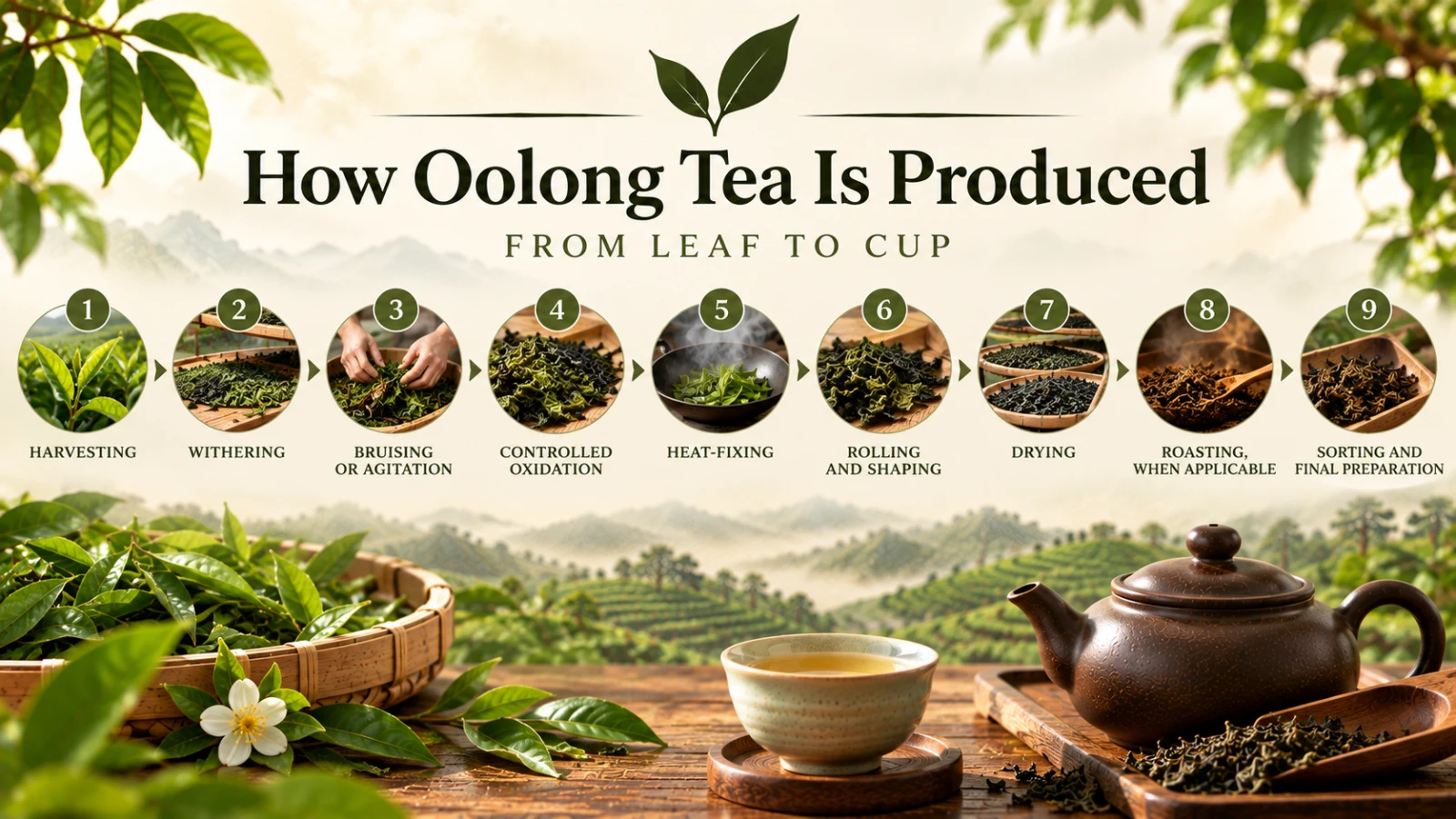
Although methods differ according to the style of oolong being made, the basic process generally includes:
- Harvesting
- Withering
- Bruising or agitation
- Controlled oxidation
- Heat-fixing
- Rolling and shaping
- Drying
- Roasting, when applicable
- Sorting and final preparation
The individual stages can overlap, and some teas may undergo several cycles of rolling, oxidation, or roasting.
1. Harvesting the Tea Leaves
Oolong production begins in the tea garden.
The quality of the harvested material depends on several factors, including the tea cultivar, growing environment, season, weather, and maturity of the leaves.
Different oolong traditions use different harvesting standards. Depending on the style, producers may harvest a bud with one or two leaves or somewhat more mature shoots.
Harvesting is important because the physical and chemical composition of the leaf influences how it responds during processing.
The leaves also need to arrive at the production facility in good condition. Excessive compression, heat, or delay after harvesting can affect the quality of the finished tea.
For traditional specialty oolong, careful handling immediately after picking is therefore an important part of production.
2. Withering
After harvesting, the leaves are spread out and allowed to wither.
Withering is essentially a controlled reduction of moisture. Fresh tea leaves contain a large amount of water, and reducing that moisture makes the leaves softer and more suitable for subsequent handling.
There are generally two forms of withering:
- Outdoor withering, where leaves are exposed to controlled natural conditions
- Indoor withering, where temperature, humidity, airflow, and other conditions can be managed more precisely
Traditional oolong production often relies on repeated observation of the leaves rather than simply following a predetermined amount of time.
During withering, important chemical and physical changes occur. The leaf becomes more flexible, moisture decreases, and aromatic compounds begin to develop.
The goal is not simply to make the leaves dry.
Oolong leaves must retain enough moisture and flexibility for the later stages of bruising, oxidation, and shaping.
3. Bruising and Agitation
One of the most distinctive aspects of many traditional oolong production methods is the deliberate bruising or agitation of the leaves.
After withering, the leaves may be shaken, tossed, or gently tumbled. This damages portions of the leaf's cellular structure.
Why does this matter?
When the cells are disrupted, compounds within the leaf come into contact with oxygen and enzymes. This encourages oxidation.
The tea maker controls the intensity and duration of this process.
Too little disruption may result in insufficient oxidation and development. Too much can cause excessive oxidation or undesirable damage.
This stage may be repeated several times.
Between periods of agitation, the leaves are allowed to rest. The tea maker examines their appearance, aroma, texture, and overall condition before deciding whether further processing is necessary.
This repeated cycle is one reason traditional oolong production requires considerable experience.
4. Controlled Oxidation
Oxidation is central to the identity of oolong tea.
It is important to distinguish oxidation from fermentation. Tea oxidation is primarily an enzymatic process in which compounds in the tea leaf react with oxygen. It is not the same process as microbial fermentation used in foods such as yogurt or certain fermented teas.
During oolong production, oxidation is intentionally controlled.
As oxidation progresses, the leaf changes in color and aroma. Fresh grassy characteristics can give way to floral, fruity, honeyed, woody, or other aromas depending on the tea.
The tea maker determines when the desired level of oxidation has been reached.
This is one of the major points at which different oolong styles diverge.
A lightly oxidized oolong may emphasize freshness, floral fragrance, and a brighter character. A more heavily oxidized tea may develop deeper fruit, honey, spice, or woody notes.
Oxidation is therefore not simply a measure of quality. It is a production choice that contributes to the intended style of the tea.
5. Heat-Fixing: Stopping Oxidation
Once the desired level of oxidation has been reached, the tea must be heated to stop or greatly reduce enzymatic activity.
This process is sometimes called fixing, kill-green, or sha qing in Chinese tea production.
Heat can be applied in different ways depending on the tea and production tradition. The purpose is to stabilize the leaf and prevent oxidation from continuing in the same way.
The timing is critical.
If heating occurs too early, the tea may not develop the desired aroma and flavor. If it occurs too late, oxidation may progress beyond the intended level.
This is another stage where production skill matters significantly.
6. Rolling and Shaping the Leaves
After oxidation has been controlled and the leaves have been heated, they are rolled or shaped.
Rolling serves several purposes.
First, it gives the tea its physical form. Oolong can be produced as tightly rolled balls, twisted strips, curled leaves, or other shapes.
Second, rolling helps influence the release of flavor and aroma during brewing.
Different oolong traditions use distinctive shaping methods.
Rolled Oolong
Some teas are rolled into compact, semi-spherical forms. This style is strongly associated with several Taiwanese and southern Fujian oolongs.
The leaves gradually unfurl when steeped.
Strip-Shaped Oolong
Other teas are twisted or rolled into long strips. Many Wuyi oolongs and other northern Fujian teas fall into this general category.
The shape of the finished tea is therefore not merely decorative. It reflects the production tradition and influences how the leaves open during brewing.
7. Drying the Tea
The shaped leaves must then be dried.
Drying reduces remaining moisture to a stable level and helps preserve the tea for storage.
The process needs to be controlled carefully. Excessive heat can alter aroma and flavor, while insufficient drying can leave too much moisture in the tea and compromise its stability.
At this stage, the tea has essentially become a finished tea product, although some oolongs undergo additional roasting.
8. Roasting Oolong Tea
Roasting is an important feature of many traditional oolongs, although not all oolong tea is roasted to the same degree.
Roasting involves exposing the finished or partially finished tea to controlled heat for a specific period.
The purpose can include developing aroma and flavor, reducing residual moisture, and changing the character of the tea.
Light roasting may subtly deepen the tea's aroma. More extensive roasting can create notes associated with toasted grain, nuts, caramel, dried fruit, wood, or spice.
Traditional roasted oolong may undergo more than one roasting session, with periods of rest between them.
This is particularly significant for certain traditional Chinese oolong styles.
Roasting should therefore be viewed as part of the tea's intended character rather than simply as a method for correcting inferior tea.
How Different Oolong Production Methods Create Different Teas
One of the most useful things to understand about oolong is that there is no single oolong production method.
The final tea can vary because of differences in:
- Tea cultivar
- Growing region
- Altitude
- Harvest season
- Leaf maturity
- Withering conditions
- Oxidation level
- Shaping technique
- Drying method
- Roasting intensity
- Producer experience
Two teas may both be classified as oolong yet taste completely different.
For example, a lightly oxidized rolled oolong may have a fresh, floral profile, while a traditionally roasted Wuyi oolong can have a deeper, mineral, roasted, or fruity character.
Neither style is inherently "better." They represent different approaches to tea production.
Major Traditional Chinese Oolong Styles
Understanding a few major regional traditions provides useful context when choosing tea.
Wuyi Oolong
Wuyi oolongs originate in the Wuyi Mountains of Fujian Province.
Many are strip-shaped and traditionally roasted. Famous examples include varieties such as Da Hong Pao and Rou Gui.
Their profiles can include roasted, mineral, woody, floral, fruity, and spice-like characteristics, depending on the tea and production method.
Anxi Oolong
Anxi County in Fujian is particularly associated with teas such as Tieguanyin.
Modern Tieguanyin can encompass different production approaches, including lighter, more aromatic styles and more traditionally processed versions.
This demonstrates how a single tea name can encompass variations in production and flavor.
Phoenix Oolong
Phoenix oolongs, including Phoenix Dancong, come from the Chaozhou area of Guangdong.
These teas are often produced as twisted leaves and are known for distinctive aromatic profiles that can vary significantly according to cultivar and processing.
Taiwanese Oolong
Taiwan has developed several important oolong traditions, including high-mountain oolong, Dong Ding, and Oriental Beauty.
Production methods vary considerably. Some emphasize lighter oxidation and minimal roasting, while others use more substantial roasting.
What Determines the Quality of Oolong Tea?
Production method is only one factor in tea quality.
When evaluating an oolong, consider the following.
Leaf Material
Healthy, appropriately harvested leaves provide the foundation for good tea.
Craftsmanship
Precise control of withering, oxidation, heating, shaping, and drying can significantly affect the final result.
Cultivar and Origin
Different cultivars naturally produce different aromas and flavors. Growing conditions also influence the character of the leaf.
Balance
Quality is not necessarily about the strongest aroma or most intense flavor. A well-made tea should generally show balance among fragrance, taste, texture, and aftertaste.
Freshness and Storage
Even well-produced tea can deteriorate if stored improperly. Oolong should generally be protected from excessive heat, moisture, strong odors, light, and unnecessary exposure to air.
How to Choose Oolong Tea
Understanding production gives you a useful framework for purchasing tea.
Rather than choosing an oolong solely according to a flavor description, look at its origin, cultivar when available, production style, harvest information, and roasting level.
If you prefer floral and fresh teas, you may want to explore lighter-oxidation and lighter-roast styles.
If you prefer deeper and more developed flavors, traditionally roasted oolongs may be more appropriate.
For greater transparency, look for sellers that provide information about where the tea comes from and how it was produced.
A clear description of origin and processing gives consumers a better basis for comparing teas than vague claims about quality.
How to Brew Oolong Tea
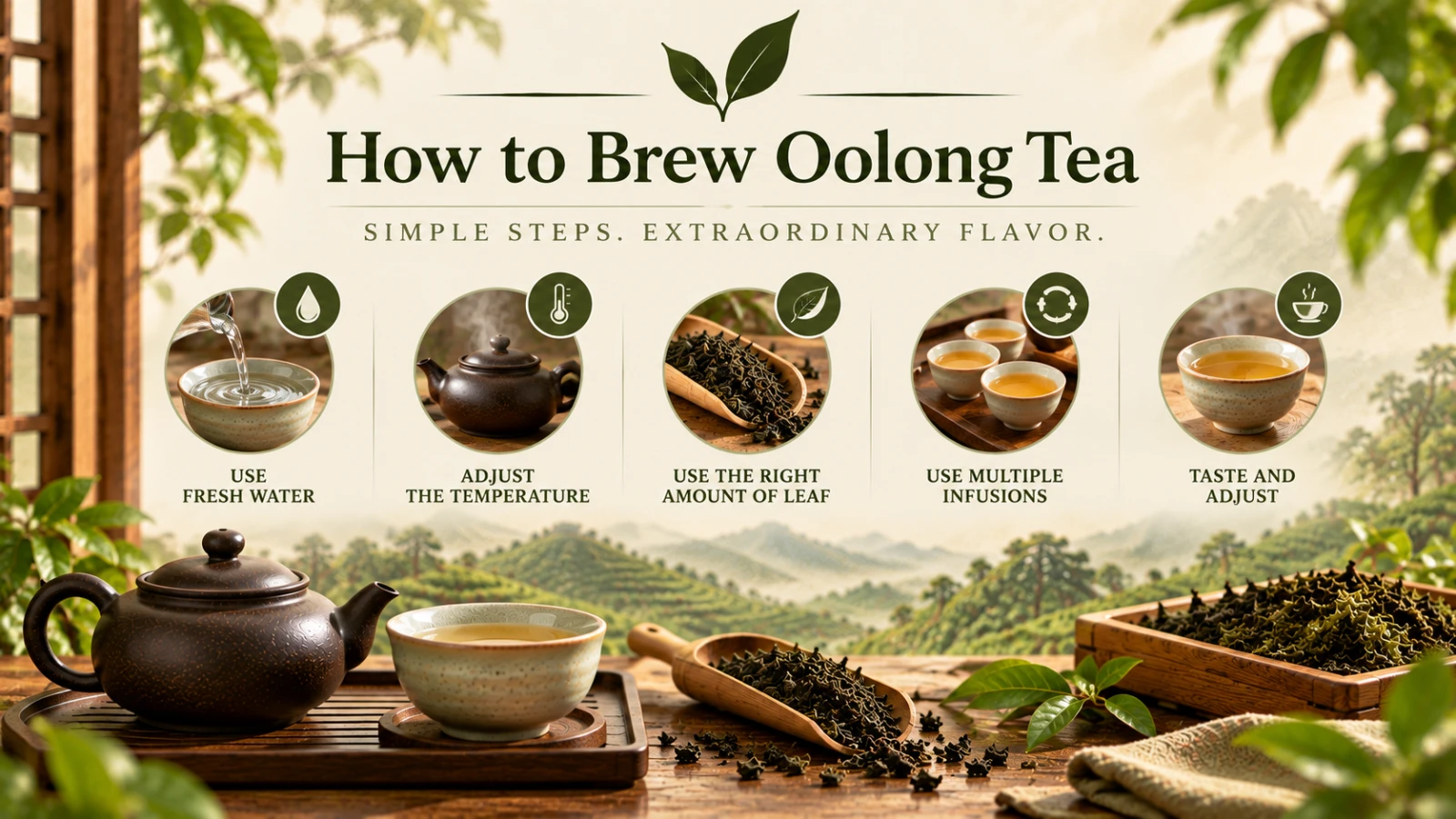
The best brewing method depends on the particular oolong, but a few general principles are useful.
Use Fresh Water
Good-quality water allows the tea's aromas and flavors to show more clearly.
Adjust the Temperature
Many oolongs respond well to relatively hot water, but the ideal temperature varies. More delicate, lightly processed teas may benefit from somewhat cooler water, while traditional roasted oolongs can often tolerate very hot water.
Pay Attention to Leaf Quantity
Oolong leaves can expand considerably during brewing, especially tightly rolled varieties.
Use Multiple Infusions
Traditional oolongs are often well suited to repeated brewing.
Instead of making one long infusion, use shorter infusions and adjust the steeping time gradually.
This allows you to observe how the tea changes as the leaves open.
Taste Rather Than Follow a Rigid Formula
Brewing recommendations are useful starting points, but they are not absolute rules. If a tea tastes too strong, reduce the amount of leaf or steep it for less time. If it tastes thin, increase the leaf quantity or steeping time.
Common Misconceptions About Oolong Production
"All Oolong Tea Is Halfway Between Green and Black Tea"
This is an oversimplification.
Oolong occupies a broad range of oxidation levels and production styles. Some oolongs may taste much closer to green tea, while others have characteristics that overlap with more heavily oxidized teas.
"Darker Oolong Is Always More Oxidized"
Not necessarily.
Color can be influenced by oxidation, roasting, leaf material, and other aspects of processing. A darker appearance does not automatically indicate a particular oxidation percentage.
"Roasted Oolong Is Lower Quality"
Roasting is a traditional production technique and can be an intentional part of a tea's character.
A well-made roasted oolong and a lightly processed aromatic oolong simply represent different styles.
"Oolong Tea Is Produced the Same Way Everywhere"
It is not.
Regional traditions, cultivars, equipment, climate, and individual tea-making practices all contribute to differences in production.
Practical Takeaways for Tea Drinkers
Understanding production can make selecting tea considerably easier.
When purchasing oolong, ask:
Where was the tea produced?
Origin provides useful information about regional tradition and growing conditions.
What cultivar was used?
Cultivar can influence aroma, flavor, and processing characteristics.
How was it oxidized?
The oxidation style helps explain whether the tea is likely to be lighter and floral or deeper and more developed.
Was it roasted?
Roasting can significantly change aroma, flavor, and body.
How should it be brewed?
Good brewing recommendations can help you experience the tea as intended.
Most importantly, don't assume that one oolong style represents the entire category. Exploring teas from different regions and production traditions is one of the best ways to understand the diversity of oolong.
Conclusion
Oolong tea is produced through a carefully controlled sequence of processes that transform freshly harvested Camellia sinensis leaves into a remarkably diverse category of tea.
Harvesting establishes the raw material. Withering reduces moisture and prepares the leaves. Agitation and bruising encourage controlled oxidation. Heating stops enzymatic oxidation at the desired stage. Rolling and shaping give the tea its characteristic form, while drying stabilizes it. For many traditional oolongs, roasting provides an additional layer of flavor and aroma.
The result is a category that encompasses everything from fresh and floral teas to deeply roasted and complex teas.
For consumers, understanding these production stages provides a practical way to evaluate oolong tea. Instead of focusing only on appearance or marketing descriptions, consider origin, cultivar, oxidation, shaping, roasting, and storage. These details help explain what is in the cup and make it easier to choose a tea that matches your preferences.
If you would like to explore authentic Chinese oolong produced according to traditional regional methods, you can browse Stepman's Tea, collection and compare teas by origin, style, and processing.
FAQs
1. How is oolong tea produced?
Oolong tea is made by harvesting, withering, bruising or agitating, partially oxidizing, heating, shaping, and drying tea leaves. Some varieties are also roasted. Processing varies by regional tradition and desired flavor profile.
2. Is oolong tea green tea or black tea?
Oolong is a distinct category of tea. It is generally partially oxidized, while green tea is processed to limit oxidation and black tea is typically more extensively oxidized.
3. Why is oolong tea partially oxidized?
Controlled oxidation helps develop the aroma, flavor, color, and texture associated with oolong tea. Tea makers determine when to stop oxidation according to the style they intend to produce.
4. What happens during oolong tea withering?
Withering reduces moisture in freshly harvested leaves and makes them more flexible. It also contributes to changes in the leaf that influence later processing and aroma development.
5. Is all oolong tea roasted?
No. Some oolongs receive little or no substantial roasting, while others undergo deliberate roasting to develop deeper aromas and flavors.
6. Does roasting make oolong tea stronger?
Roasting changes the tea's aroma and flavor, often introducing toasted, nutty, woody, or caramel-like notes. It does not necessarily mean the tea has more caffeine or is stronger in every sense.
7. What is the difference between rolled and strip-shaped oolong?
Rolled oolong is shaped into compact forms that gradually unfurl during brewing. Strip-shaped oolong is twisted or rolled into elongated leaves. The shapes reflect different processing traditions.
8. Which Chinese regions are known for oolong tea?
Fujian and Guangdong are two important Chinese oolong-producing provinces. Fujian is associated with Anxi and Wuyi oolongs, while Guangdong is known for Phoenix Dancong.
9. How can I choose a good-quality oolong tea?
Consider the tea's origin, cultivar, processing style, oxidation, roasting, freshness, and storage. Clear sourcing information and appropriate brewing guidance can help you evaluate a tea.
10. How should oolong tea be stored?
Store oolong in a clean, airtight container away from light, moisture, heat, and strong odors. Follow the seller's guidance for the particular tea, especially for traditionally roasted or intentionally aged varieties.